Games Released in 1981

446 new games debuted in 1981 across 10 platforms, with Arcade seeing 36 releases. December was the busiest month, with 51 releases. Galaga was the most popular release of the year.

Which days had the most releases?

December 31 was the busiest single day of 1981 with 47 releases.
Which month had the most releases?

The busiest release month of 1981 was December, totaling 51 titles.

How did each season compare?

Q4 was the busiest quarter of 1981 with 64 releases.

Q1 (Jan–Mar)

33 releases
New Rally-X

Most popular release in Q1

New Rally-X

New Rally-X is a maze and driving arcade game that was released by Namco in 1981. It runs on similar hardware to that of its predecessor, and as its name suggests, it is a revised version of that title, which was released in the previous year. The only differences are that it has slightly enhanced graphics, easier gameplay, a new soundtrack, and a "Lucky Flag" (with the letter "L") that gives the player extra points for remaining fuel when collected, after which the round will continue if there are still flags remaining. The mazes are mostly identical, with some of the blocks from Rally-X changed into roads to reduce dead ends, and some different flag (and rock) locations. This title was manufactured in greater numbers and was much more popular in Japan than its predecessor.

Q3 (Jul–Sep)

15 releases
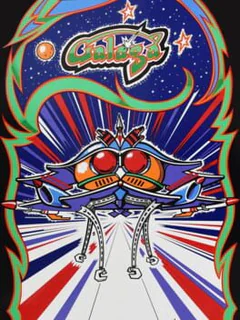
Galaga

Most popular release in Q3

Galaga

The objective of Galaga is to score as many points as possible by destroying insect-like enemies. The player controls a starfighter that can move left and right along the bottom of the playfield. Enemies swarm in groups in a formation near the top of the screen, and then begin flying down toward the player, firing bombs at the fighter. The game ends when the player's last fighter is lost, either by colliding with an enemy or one of its bullets, or by being captured. Galaga introduces a number of new features over its predecessor, Galaxian. Among these is the ability to fire more than one bullet at a time, a count of the player's "hit/miss ratio" at the end of the game, and a bonus "Challenging Stage" that occurs every few levels, in which a series of enemies fly onto and out of the screen in set patterns without firing at the player's ship or trying to crash into it. These stages award a large point bonus if the player manages to destroy every enemy. Another gameplay feature new to Galaga is the ability for enemies to capture the player's fighter. While the player is in control of just one fighter, a "boss Galaga" (which takes two shots to kill) periodically attempts to capture the fighter using a tractor beam. If successful, the fighter joins the enemy formation. If the player has more lives remaining, play resumes with a new fighter. The captured fighter flies down with the enemy that captured it, firing upon the player just like normal enemies, and can be shot and destroyed. The player can free the fighter by destroying the boss Galaga while in flight, causing the captured fighter to link up with the player's current fighter, doubling his or her firepower but also making a target twice as large. Galaga has an exploitable bug that can cause the attackers to stop firing bullets at the player, due to a coding error. In addition, similar to the famous "Split-Screen bug" in Pac-Man, a bug exists in Galaga in which the game "rolls over" from Level 255 to Level 0. Depending on the difficulty setting of the machine, this can cause the game to stall, requiring that the machine be reset or power-cycled in order to start a new game.

Q4 (Oct–Dec)

64 releases
Tempest

Most popular release in Q4

Tempest

Tempest is a 1981 arcade game by Atari Inc., designed and programmed by Dave Theurer. It takes place on a three-dimensional surface, sometimes wrapped into a tube, which is viewed from one end and is divided into a dozen or more segments or lanes. The player controls a claw-shaped spaceship (named Blaster) that crawls along the near edge of the playfield, moving from segment to segment. Tempest was one of the first games to use Atari's Color-QuadraScan vector display technology. It was also the first game to allow the player to choose their starting level (a system Atari dubbed "SkillStep"). This feature increases the maximum starting level depending on the player's performance in the previous game, essentially allowing the player to continue. An official port was released for the Atari ST. An official port that bears the Atari logo was released by Superior Software for the BBC Micro and Acorn Electron in 1985, and another by Electric Dreams for the ZX Spectrum and Amstrad CPC in 1987. Versions for the Atari 2600 and 5200 were in the works in Atari, Inc. during 1984, and unfinished prototypes exist for both of them.

Which platforms saw the most releases?

Arcade received 36 new titles in 1981, holding the most releases. The runner up was Apple II with 26 new titles.

Arcade36 releases
Apple II26 releases
TRS-8019 releases
Atari 8-bit13 releases
Game & Watch12 releases
Intellivision8 releases
Texas Instruments TI-997 releases
Odyssey 2 / Videopac G70006 releases
Atari 26004 releases
Epoch Cassette Vision4 releases

What genres were most popular?

Arcade was the dominant genre in 1981 with 67 titles. Shooter followed closely with 46.

Arcade67
Shooter46
Strategy23
Sport12
Adventure11
Simulator11
Puzzle9
Platform5
Racing4
Role-playing3